Saker Falcon
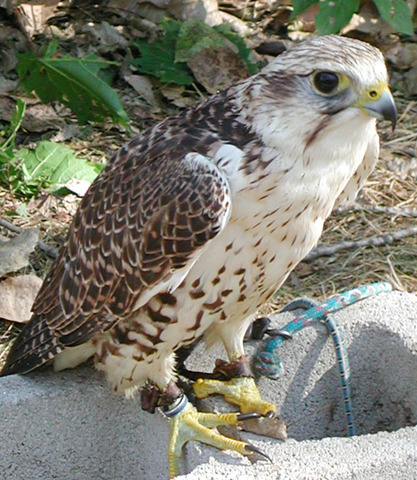

Taxonomy
| Domain | Eukaryota |
|---|---|
| Kingdom | Metazoa |
| Phylum | Chordata |
| Class | Aves |
| Order | Falconiformes |
| Family | Falconidae |
| Genus | Falco |
| Species | Falco cherrug |
| (U.S. Fish & Wildlife Service, n.d.; National Library of Medicine, n.d.) |
There are 4 Subspecies of Saker Falcons: (Encyclopedia of Life, n.d.)
- Falco cherrug cherrug
- Falco cherrug coatsi
- Falco cherrug hendersoni
- Falco cherrug milvipes
Where to find a Saker Falcon
Let's say you want to see this beautiful birds in person. Well, first you need to figure out where to find these birds! The main continents you can find these birds in are Europe, Asia, & Northern Africa (The Pegerine Fund, n.d.)
Along with the continents, Saker Falcons live in a diverse range of habitats. They will live in grasslands, forests, deserts, mountains, and more (International Wildlife Consultants Ltd., n.d.).


Here is a list of 3 Adaptive Traits
Curved talons: These are useful as they allow for a falcon to swoop down and catch their prey with ease.
Wings: Yes, all birds have these. However, these are especially important to the Saker Falcon as wings are their key to flying, hunting, and courting.
Nests: Sakers do not make their own nests. Why build your own nest when you can just steal the nest of another bird? Bonus points if its abandoned and the saker can come back to it each year.
How do the bird make more birdies?
Attracting a Mate
In order for a male Saker Falcon to atract a mate, they must preform ariel displays. During these displays, these birds will call loudly. Saker Falcons may also bow or provide food to possible mates (Hekman, n.d.).
Laying Eggs
When it comes to nesting, Saker Falcons will use the nests built by other birds. Sometimes, Sakers will drive away other birds in order to use their nests. If a Saker Falcon can not find an already built nest, they may lay their eggs with no nest at all (The Pegerine Fund, n.d.). There have been no instances recorded where a Saker Falcon has built their own nest (Hekman, n.d.).
The breeding season for Saker Falcons last from March-April. They will lay clutch sizes of 4-5 eggs and the first eggs will hatch about 31-32 days later (International Wildlife Consultants Ltd., n.d.).
Both genders do incubation. Early in the process, the female will do most of the incubation while the male does most of the hunting. Later, both will do hunting for the hatchlings (International Wildlife Consultants Ltd., n.d.).
Anatomical Structures
Since the Sakor Falcon is an endagered and a not as popularily doucmented species, most of these structures will be based off of falcons and birds overall
Skeletal Structure

Birds in general share the same structure for wings. This structure allows them to morph their wings to adapt to any situation (Tang, et al., 2024).
Digestive System
Birds in general share the same digestive system. When a falcon eats its prey, the food will move to the crop. In the crop, the gizzard stones will break down food. Once a falcon is old enough, it will regurgitate bones and feathers in order to keep its digestive tract clean (Weiss, 2022).
Respiratory System
The bird respiratory system works in two breathing cycles. In its first breath, the air is moved to the posterior air sacs and then into the lung where the oxygen is absorbed. On the second breath, the air moves to the anterior air sacs and then is expelled through the nares (Mendenhall, n.d.).
Circulatory System
Birds have a 4 chambered heart. It is efficient at keeping unoxygenated blood seperated from oxygenated blood and delievering the most amount of oxygen possible to the cells. A bird's heart is porportionately bigger to its body compared to a human's heart to a human body (Bennett, n.d.).
What does a Saker Falcon eat?
A Saker Falcon will eat small animals and sometimes medium sized birds. These flacons snatch prey from the ground or midair if the prey is a bird (The Pegerine Fund, n.d.). Like described earlier, food moves to the crop and is broken down by gizzard stones (Weiss, 2022).
References
Bennett, J. (n.d.). Bird Circulatory System | Heart, Structure & Functions. Retrieved from Study.com: https://study.com/academy/lesson/bird-circulatory-system-function-structure.html
Encyclopedia of Life. (n.d.). Saker Falcon. Retrieved from Encyclopedia of Life: https://eol.org/pages/45514168
Hekman, V. (n.d.). Falco cherrug. Retrieved from Animal Diversity Web: https://animaldiversity.org/accounts/Falco_cherrug/
International Wildlife Consultants Ltd. (n.d.). Breeding and Biology. Retrieved from International Wildlife Consultants Ltd.: https://www.falcons.co.uk/conservation-research-and-welfare/the-saker-falcon/breeding-and-biology/
Mendenhall, C. D. (n.d.). How Birds Breathe with their Butts. Retrieved from Carnegie Museum of Natural History: https://carnegiemnh.org/how-birds-breathe-with-their-butts/
National Library of Medicine. (n.d.). Taxonomy Browser. Retrieved from National Library of Medicine: https://www.ncbi.nlm.nih.gov/datasets/taxonomy/browser/?taxon=345164
Tang, D., Shi, W., Liu, D., Yang, Y., Zhu, L., & Xu, L. (2024, April). Quantitative analysis of the morphing wing mechanism of raptors: Bionic design of Falco Peregrinus wing skeleton. Retrieved from National Library of Medicine: https://pmc.ncbi.nlm.nih.gov/articles/PMC10986943/
The Pegerine Fund. (n.d.). Saker Falcon. Retrieved from The Pegerine Fund: https://peregrinefund.org/explore-raptors-species/falcons/saker-falcon
U.S. Fish & Wildlife Service. (n.d.). Saker Falcon. Retrieved from U.S. Fish & Wildlife Service: https://www.fws.gov/species/saker-falcon-falco-cherrug
Weiss, L. (2022). Prey and Hunting. Retrieved from UMassAmherst Library: https://openbooks.library.umass.edu/thefalconproject/chapter/prey-and-hunting/
Social Patterns & Activity
Saker Falcons are not very social birds. They prefer to keep their nests away from other falcons. (Hekman, n.d.)
Saker Falcons are described to be agressive hunters (Hekman, n.d.)
Saker Falcons are diurnal (Hekman, n.d.)